
POSTED BY:
COMMENTS:
0
POST DATE:
The Global Directory of Policy-Defining Organizations in Education
For academic leaders, researchers, and institution directors, navigating the global educational landscape requires knowing who actually defines the standards. While many organizations implement local programs, only a select group of global entities shape international policy, curricula, and quality benchmarks.
This directory categorizes the world's most influential educational authorities, dividing them into Global Anchors (the macro-policy and funding giants) and Sectoral Pioneers (the specialized bodies governing specific fields).
The Global Anchors
These intergovernmental and treaty-based organizations establish the high-level policy frameworks, structural funding, and systemic benchmarks that national governments adopt.
The European Commission - Directorate-General for Education, Youth, Sport and Culture
The European Commission is a dominant force in global education policy. Its work focuses on creating seamless cross-border learning systems and setting strict, high-quality benchmarks for digital transition and professional skills.
- Key Frameworks: The European Education Area (EEA) Strategic Framework (guiding EU-wide cooperation through 2030) and the Digital Education Action Plan.
- Policy Impact: The Commission drives the standardization of global education through the ECTS (credit transfer system), the European Qualifications Framework, and European Universities Alliances. It is currently leading the global transition toward standardized micro-credentials and guidelines for the ethical use of AI in classrooms.
UNESCO (United Nations Educational, Scientific and Cultural Organization)
As the United Nations' specialized agency for education, UNESCO is the ultimate global coordinator of educational policy, tasked with monitoring progress toward Sustainable Development Goal 4 (SDG 4).
- Key Frameworks: The Transforming Education initiative and the Global Education Monitoring (GEM) Report.
- Policy Impact: UNESCO sets global normative standards, particularly concerning access, equity, and inclusive digital futures. It currently leads international discussions on global AI governance in education, defending intellectual autonomy and multilingualism in digital spaces.
The OECD (Organisation for Economic Co-operation and Development)
The OECD advises developed and developing nations on economic and educational policies, using deep data analysis to steer national curricula.
- Key Frameworks: The PISA (Programme for International Student Assessment) and the annual Education at a Glance report.
- Policy Impact: By measuring how well 15-year-old students perform in reading, mathematics, and science worldwide, the OECD directly influences what subjects national ministries of education prioritize.
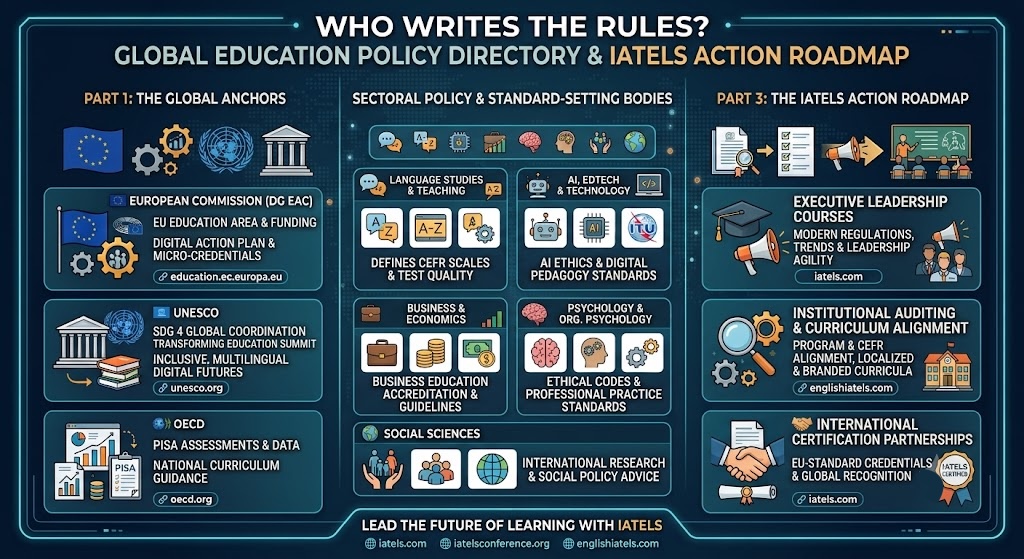
Sectoral Policy & Standard-Setting Bodies
Beyond macro-level funding, these specialized international networks and professional associations define the specific curricula, ethical codes, and quality assurance metrics for individual disciplines.
Language Studies & Language Teaching
These organizations govern how languages are taught, assessed, and certified internationally, defining the linguistic benchmarks used in global commerce and academia.
- ALTE (Association of Language Testers in Europe): Sets the strict quality standards for European language examinations and maintains the auditing frameworks that validate language proficiency profiles. Explore their work at alte.org.
- FIPLV (Fédération Internationale des Professeurs de Langues Vivantes): The only international non-governmental organization representing teachers of modern languages, advising UNESCO on multilingual education policies. Learn more at fiplv.org.
- ACTFL (American Council on the Teaching of Foreign Languages): Known globally for its proficiency scales, defining the standard progression of language acquisition from novice to superior levels. Read their guidelines at actfl.org.
AI, EdTech, & Technology
These organizations set the technical standards, safety protocols, and pedagogical boundaries for integrating digital tools into the learning process.
- IEEE Education Society: Establishes international engineering standards, technical curricula, and quality frameworks for online learning systems, immersive classrooms, and educational software. Visit ieee-education.org.
- IAIED (International Alliance for Artificial Intelligence in Education): A leading global group of researchers and developers defining the ethical use, algorithmic fairness, and cognitive safety of AI tools in educational settings.
Business Management & Economics
These elite accreditation networks and academic associations ensure business education evolves alongside the needs of the global economy.
- AACSB (Association to Advance Collegiate Schools of Business): The gold standard of business school accreditation globally, defining curriculum quality, faculty research standards, and institutional leadership. Explore their criteria at aacsb.edu.
- EFMD (European Foundation for Management Development): Runs the EQUIS accreditation system, driving internationalization, corporate connection, and social responsibility in business curricula. Learn more at efmdglobal.org.
- IEA (International Economic Association): A global network of economic associations that shapes academic research priorities and advises international policymakers on economic education.
Psychology & Organizational Psychology
These professional bodies govern the ethical codes, academic standards, and clinical/organizational practices of psychological sciences.
- IUPsyS (International Union of Psychological Science): The global umbrella organization representing over a million psychologists, responsible for establishing universal ethical standards and academic curricula. Visit iupsys.net.
- IAAP (International Association of Applied Psychology): The oldest international association in the field, defining standards for applied psychological practices, including environmental, clinical, and educational psychology. Find details at iaap.org.
- EAWOP (European Association of Work and Organizational Psychology): Sets the professional competence standards and research agendas for occupational and organizational psychologists across Europe. Learn more at eawop.org.
Social Sciences
These organizations coordinate international research, advising governments on social policy, human rights, and cultural preservation.
- International Science Council (ISC): A global non-governmental organization that brings together over 200 international scientific unions, integrating social and natural sciences to advise on global policy. Explore their initiatives at council.science.
- UNESCO-MOST (Management of Social Transformations): UNESCO’s intergovernmental science program that promotes the improvement of social science research to help policymakers manage rapid societal transitions.
Navigating Laws, Policies, Rules — IATELS Action Roadmap
Knowing who writes the rules is only the first step. For institutional directors, university boards, and policy architects, the real challenge is navigating and applying these rapid regulatory shifts without disrupting daily operations.
To help institutions bridge the gap between abstract policy and classroom-ready success, IATELS acts as an operational guide, offering targeted consultancy, auditing, and specialized education programs:
Courses & Briefings for Education Leaders & Policymakers
We design and deliver highly interactive, executive-level training modules and masterclasses specifically for academic decision-makers. These courses focus on:
- Deciphering Global Educational Regulations: Stay ahead of the latest EU, UNESCO, and OECD mandates regarding qualification equivalence, curriculum frameworks, and quality assurance.
- Governing AI and Digital Pedagogy: Learn how to design institutional policy on generative AI, balancing technological integration with the preservation of student cognitive skills and academic integrity.
- Educational Leadership & Agility: Equipping department chairs and school owners with strategies to manage curriculum transitions, evaluate international trends, and mitigate teacher burnout.
Institutional Auditing & Curriculum Alignment Services
If your institution wants to match the elite benchmarks set by the standard-setting bodies highlighted in this directory, IATELS provides hands-on curriculum alignment:
- Linguistic Alignment (ALTE/CEFR): We audit your language departments to ensure your teaching and assessment practices strictly align with modern European standards. For schools seeking a fully customized approach, we develop and publish custom, co-branded school textbooks via englishiatels.com.
- Sectoral Excellence Audits: We evaluate your business, social science, and psychology curricula, guiding your department heads toward global academic accreditation.
EU-Aligned International Certification Partnership
Bring immediate international validation to your academy, center, or institute. Through our co-branding and certification partnership, IATELS works with regional training providers to verify their curriculum. Once certified, partner institutions can issue internationally recognized, EU-standardized, and digitally verifiable credentials in Professional Pedagogy, Business Leadership, Languages, and Applied Technologies.
Lead the Future of Learning: Don’t just follow the rules—set the standard. Connect with our global network of researchers, access peer-reviewed publishing paths, or enroll your leadership team in our next regulatory masterclass.
- Browse Our Leadership & Policy Courses: iatels.com
- Present Your Research at Our International Forums: iatelsconference.org
- Build Your Custom School Curriculum: englishiatels.com
