
IATELS can act as an international accreditation body for curriculum standards, professional training, and institutional quality.
This power does not come from a national government; it comes from a specific model known as Peer-Review and Association-Based Accreditation.
As an international academic organization dedicated to the advancement of technology, education, and language studies, the International Association for Technology, Education and Language Studies (IATELS) serves as an independent global body for quality assurance, professional accreditation, and curricular validation.
We bridge the gap between traditional national educational structures and the rapidly evolving demands of the global corporate and academic sectors.
What Gives IATELS the Right to Accredit?
In international education, accreditation generally falls into two categories:
-
Statutory/National Accreditation: This is granted by a ministry of education (like the Turkish Higher Education Council – YÖK, or the US Department of Education) strictly for granting academic degrees within a specific country. IATELS is not a government ministry, so it does not issue national degrees.
-
International Professional/Association Accreditation: This is where professional bodies, NGOs, and international associations certify that an independent curriculum, training center, or school meets global industry standards.
IATELS Authority is Built on Three Pillars:
-
The Power of the Expert Board: As an international association, IATELS Board consists of active academic professionals and international researchers. Accreditation is essentially a peer-review process. IATELS right to evaluate others comes from the documented academic standing, publications, and expertise of the IATELS leadership and its global academic network.
-
NGO and Corporate Legitimacy: Operating through an international organizational structure gives IATELS the legal mandate to establish quality standards, issue certifications, and validate educational frameworks globally.
-
Transnational Curricular Standards: When IATELS evaluates an institution, it checks if their curriculum aligns with international standards—such as the Common European Framework of Reference for Languages (CEFR) or the latest digital literacies mapped out by institutions like Cambridge. IATELS validates industry excellence, not local government compliance.
IATELS – Independent Global Quality Assurance and Professional Accreditation Body
Core Terms and Notions:
-
“Institutional Certification & Curriculum Validation”
-
What it means: IATELS certifies that the institution’s programs meet international, tech-integrated benchmarks.
-
-
“International Quality Assurance Stamp”
-
What it means: IATELS provides an external audit of the insitution’s teaching methodologies to ensure they are up to modern global standards (e.g. AI-powered literacy frameworks, etc.).
-
-
“Global Association-Backed Accreditation”
-
What it means: IATELS explicitly states that this is an international, non-governmental professional benchmark that prepares students for global corporate environments, not local civil service exams.
-
“We provide IATELS International Curricular Accreditation.
It means that an independent, global board of academic experts has audited training programs, confirming that they meet modern international standards for learning and teaching in this subject area.
When the institution’s students graduate, they don’t just get a local attendance certificate; they receive a co-branded certificate bearing the IATELS International Validation Stamp, giving them a competitive edge in the global market.”
IATELS Legal and Institutional Authority
IATELS operates as a global network governed by an international board of leading professors, researchers, and educational innovators. Our authority to validate and accredit educational programs is rooted in three distinct pillars:
-
Peer-Review Excellence: Accreditation is fundamentally an evaluation by peers. Our right to assess educational standards is derived directly from the documented academic standing, international publications, and domain expertise of the IATELS Board and global scientific committee.
-
Transnational Curricular Benchmarking: We evaluate language, social studies, psychology, business, management, technology and related programs against modern, global frameworks—such as the Common European Framework of Reference for Languages (CEFR) state-of-the-art digital and AI literacy standards, other related subject-based frameworks.
-
Independent Quality Assurance (IQA): IATELS provides non-governmental, international professional accreditation. We do not replace local statutory licensing (ministries of education); instead, we add a premium layer of global validation that certifies your students are ready for international academic environments and cross-border corporate industries.
Frameworks of Accreditation
Institutions can apply for IATELS Quality Assurance Stamps across three primary domains:
1. Curricular Validation
We audit your training syllabi, textbooks, and lesson structures to ensure they meet modern global standards. Validated curricula receive the “IATELS Internationally Approved Curriculum” designation, certifying that your course design actively incorporates international subject-focussed frameworks and advanced educational methodologies.
2. Institutional Quality Accreditation
This is granted to private language academies, international colleges, corporate training providers, and educational centers that meet our rigorous standards for instructional delivery, teacher readiness, and digital resource integration.
3. Professional Development Program Certification
We validate independent workshops, corporate masterclasses, and specialized teacher-training modules. Programs that pass our quality audit are authorized to grant IATELS-backed micro-credentials and professional certificates.
The Commercial and Academic Value to Your Institution
Partnering with IATELS distinguishes your institution in a crowded, competitive educational marketplace.
-
Global Differentiation: Position your organization above local competitors by demonstrating that your programs are independently audited and certified by an international body.
-
Co-Branded Certification: Graduating students receive an international validation stamp on their certificates, significantly increasing their career mobility and portfolio value in the global market.
-
Curriculum Optimization: Gain access to IATELS expert feedback during the evaluation process to seamlessly integrate emerging competencies—such as AI-powered language learning, advanced prompt engineering, and critical algorithmic literacy—into your existing courses.
-
Global Academic Visibility: Accredited institutions are integrated into the wider IATELS ecosystem, unlocking priority collaboration opportunities for international conferences, joint research projects, and global networking.
The Accreditation Process
To maintain absolute academic integrity, our evaluation process is straightforward, thorough, and structured across four clear phases:
┌──────────────────────┐      ┌──────────────────────┐      ┌──────────────────────┐      ┌──────────────────────┐
│  1. APPLICATION &    │ ──>  │   2. CURRICULAR &    │ ──>  │    3. BOARD DECREE   │ ──>  │ 4. ISSUANCE OF STAMP │
│   DOCUMENT SUBMISSION│      │   METHODOLOGY AUDIT  │      │     & RATIFICATION   │      │    & MONITORING      │
└──────────────────────┘      └──────────────────────┘      └──────────────────────┘      └──────────────────────┘
-
Application & Self-Assessment: The institution submits its educational materials, teaching methodologies, and faculty profiles for initial administrative screening.
-
The Peer-Review Audit: Members of the IATELS Academic Board evaluate the submission against international benchmarks for quality, communicative efficacy, and modern technological integration.
-
Ratification: Upon a successful review, the IATELS Board issues an official Decree of Accreditation.
-
Continuous Quality Maintenance: The accredited status is granted for a multi-year term, supported by periodic quality checks to ensure continuous alignment with global educational standards.
Begin Your Institutional Evaluation
Elevate your educational offerings to an internationally recognized standard. Contact our Quality Assurance Committee today to request the formal accreditation guidelines and preliminary application forms.
📥 Apply for Institutional Partnership: info@iatels.com; iatels.association@gmail.com; start.inforum@gmail.com.
IATELS News and Expert Articles
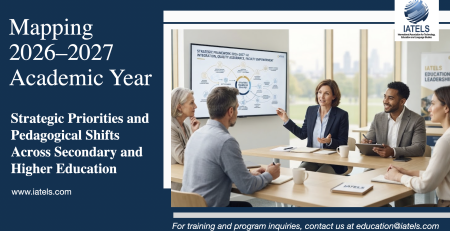
Mapping the 2026–2027 Academic Year
As the new academic year commences, the educational landscape across secondary (high school) and tertiary (university) levels is defined by...
IATELS Education: Course Ecosystem Overview
The rules of the professional landscape are rewriting themselves overnight. Artificial intelligence is reshaping workflows, global markets demand instant cross-border...
Navigating the Future of Education
The global education landscape is undergoing a profound paradigm shift driven by technological disruption, ecological crises, and geopolitical transformations. As...
Mastering the Rational and Emotional Drivers of Today’s Buyer
Why do we buy what we buy? If you ask a consumer, they might point to a spreadsheet of features...Legal Framework & Regulatory Compliance
The quality assurance audits, curricular validations, and institutional certifications issued by IATELS and its operating partners are legally grounded in national and transnational statutory provisions governing independent professional bodies, contractual freedom, and non-governmental academic peer-review.
1. Transnational and European Educational Directives
-
The European Qualifications Framework (EQF) & CEFR Alignment: Pursuant to the Council of the European Union’s recommendations on validating non-formal and informal learning, independent professional organizations hold the right to benchmark educational and vocational training against the Common European Framework of Reference for Languages (CEFR).
-
The WTO General Agreement on Trade in Services (GATS): Under international trade law, private and non-governmental educational services, cross-border training validation, and professional skill certifications are fully permitted under market access provisions for independent commercial and educational consultants via the World Trade Organization GATS Legal Text.
2. Local Association and Corporate Legislation (Turkey)
-
The Turkish Law on Associations (Dernekler Kanunu No. 5253): In accordance with Article 5 and related operational clauses, established associations possess the legal capacity to determine institutional objectives, implement peer-reviewed international frameworks, and establish quality-assurance guidelines within their designated scientific or professional fields. Read the full statute on the Republic of Türkiye Ministry of Interior Directorate General of Relations with Civil Society Website.
-
The Turkish Civil Code (Türk Medeni Kanunu No. 4721): This code provides independent legal personality to associations, guaranteeing their right to enter into transnational partnerships, evaluate external educational methodologies, and issue non-governmental certificates of competency or validation. Review the official law on the Republic of Türkiye Ministry of Justice Legislation Database.
-
The Turkish Commercial Code (Türk Ticaret Kanunu No. 6102) & Freedom of Contract: Through corporate operators like STARTINFORUM LTD, the organizational network utilizes the fundamental right to Freedom of Contract (under the Turkish Code of Obligations). This permits the commercial execution of B2B audit agreements, institutional setups, and the licensing of validated educational intellectual property (IP). Access the complete commercial statute via the Ministry of Justice Official Publication.
3. Voluntary and Non-Statutory Nature of Accreditation
-
Independent Quality Infrastructure (TÜRKAK Framework): In alignment with global standardization practices, professional curricular accreditation is an entirely voluntary market mechanism. It does not claim to replace or mimic national statutory degrees issued by state ministries (such as YÖK or MEB). Instead, it serves as an independent, market-driven quality stamp that verifies readiness for international corporate and transnational academic settings. Reference these standard practices on the Turkish Accreditation Agency (TÜRKAK) Official Portal.